

Account Types
Income-oriented ETFs are typically held in one of three types of investment accounts. With potential tax implications, there is some ability to move funds between the account types:
Traditional (tax-deferred) IRA
Roth (tax-paid) IRA
Taxable brokerage account
How Each Account Type is Taxed
Traditional (Tax-Deferred) IRA
The primary advantage of contributing to a Traditional IRA is that, subject to IRS eligibility rules, contributions may be tax-deductible in the year they are made. This allows more money to be invested and compounding sooner than if income taxes had been paid first.
Once inside the account, dividends, interest, capital gains, and price appreciation all grow tax-deferred. No taxes are due on investment earnings as long as the assets remain in the IRA.
When funds are withdrawn, distributions are generally taxed as ordinary income, regardless of whether the earnings originally came from interest, dividends, capital gains, return of capital or price appreciation. As a result, investments that would otherwise receive preferential tax treatment in a taxable brokerage account—such as qualified dividends or long-term capital gains—lose that advantage when distributed from a Traditional IRA.
Roth IRA
A Roth IRA is often—but not always—the most tax-advantaged account available to individual investors.
Unlike a Traditional IRA, contributions are made with after-tax dollars, so there is no upfront tax deduction. In exchange for paying taxes today, all future investment earnings receive highly favorable tax treatment.
Once the money is invested, dividends, interest, capital gains, and price appreciation all accumulate tax-free.
Provided IRS requirements for qualified distributions are met, withdrawals—including both the original contributions and all investment earnings—are completely free of federal income tax.
Because future investment growth is never taxed, a Roth IRA is often an ideal home for investments with the greatest long-term appreciation potential. Decades of dividends, capital gains, and compound growth can accumulate and ultimately be withdrawn without further federal income tax, making the Roth IRA one of the most powerful wealth-building tools available.
Taxable Brokerage Account
A taxable brokerage account offers no tax shelter, so all contributions are after-tax, but it does provide the opportunity for certain types of investment income to receive preferential tax treatment.
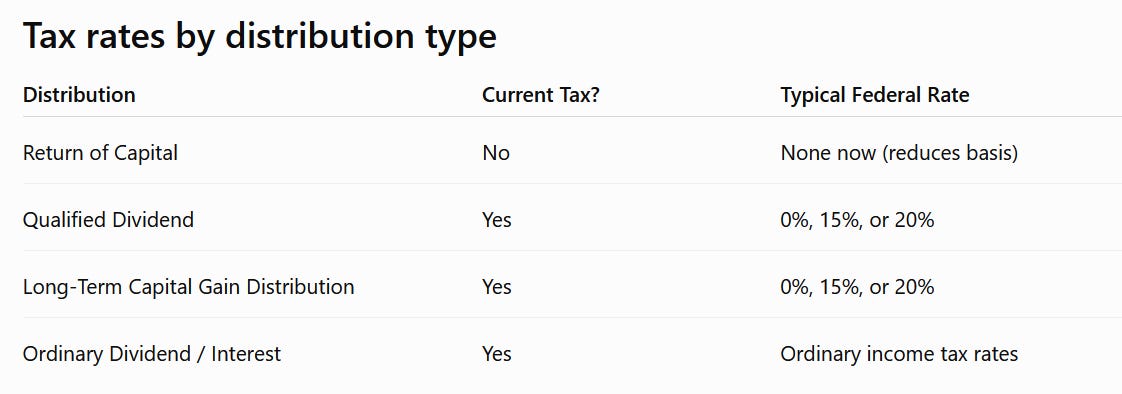
Depending on the specific ETF, and the character of its distributions, investors may receive:
Ordinary income
Qualified dividends
Long-term capital gain distributions
Return of Capital (ROC)
Each character of distribution is taxed differently, and those differences can significantly affect an investor’s after-tax return.
The tax character is determined after year-end and appears on your Form 1099-DIV provided by the brokerage.
In addition, any increase in the value of the ETF (price appreciation) is generally not taxable until the shares are sold. If held for more than one year, those gains typically qualify for favorable long-term capital gains tax rates.
ETF Example 1 : SPYI
SPYI is probably the most tax-efficient income ETF available today, making it attractive within Taxable Brokerage Accounts.
Historical Distribution (for example, 2024):
~94% Return of Capital
Small amount Ordinary Dividend
Very little capital gain distribution
Tax consequences
Suppose you own 100 shares and receive $5/share distribution
If 95% is ROC, then $475 of the distribution is not taxable today.
But with ROC, your cost basis is reduced.
ROC example: Purchased at $50/share (basis = $50), and receive $5 ROC, new basis = $45. No current tax. But eventually when sold, say sold at $60, taxable gain is $60−45 = $15 instead of $60−50 = $10. The tax is deferred, not eliminated.
Price appreciation
Any increase in share price is taxed normally, but only when distributed:
Short-term (<1 year): ordinary income rates
Long-term (>1 year): capital gains rates
ETF Example 2 : CAIE
CAIE distributions generally come from:
option income
interest-like income
structured note payments
Therefore distributions tend to be
mostly ordinary income
occasionally capital gains
relatively little ROC
Ordinary income is taxed at your marginal federal tax rate (plus state tax where applicable). The exact mix can vary from year to year depending on portfolio activity.
Price appreciation is taxed as normal capital gains when shares are sold.
ETF Example 3 : UTF
UTF is a closed-end fund. Its distributions are usually a mixture of:
Qualified dividends
Long-term capital gains
Return of Capital
The proportions vary from year to year.
Qualified dividends are usually taxed at either:
0%
15%
20%
Rate depends upon total taxable income. These are usually much better rates than ordinary income.
Capital gains also receive favorable long-term capital gains rates.
Return of Capital is not taxable immediately, but basis is reduced.
Example: Purchase at $30 / share, receive $2 ROC. New basis is $28. Sell later for $35, capital gain becomes $7 instead of $5
ETFs by Account Type
Traditional IRA
These funds generally produce a large amount of ordinary income, making them good candidates for tax deferral within a Traditional IRA:
PDI – Bond income (mostly ordinary income)
JEPI – Mostly ordinary income from option strategy
JEPQ – Mostly ordinary income from option strategy
CAIE – Structured-note income, largely ordinary
TRIN – BDC dividends, generally ordinary income
ARCC – BDC dividends, generally ordinary income
SRV – Utility CEF with significant ordinary income
LGI – Covered-call strategy, relatively tax-inefficient
OVF – Option-income strategy (assuming Virtus option-income fund)
Roth IRA
These are funds where you would ideally never pay tax on years of compounding because you expect meaningful long-term appreciation. These have high expected long-term capital appreciation, and in a Roth, future gains become permanently tax-free.
SPY
QDVO
GPIQ
QQQI
IWMI
IAUI
PEO
MO
Taxable Brokerage Account
These funds tend to generate a favorable mix of qualified dividends, long-term capital gains, or Return of Capital (ROC), making them well suited for taxable brokerage accounts. Note we divide them into two tiers:
Tier 1 – Excellent for Taxable Account
SPYI
SPY
UTF
UTG
ADX
PEO
Tier 2 – Acceptable for Taxable Account
AGD
AOD
IDE
MO
Funds for “Any Account”
These funds have mixed tax characteristics and can reasonably fit in more than one type of account depending on your objectives.
IAUI
GPIQ
QDVO
Conclusion
Understanding the character of an ETF’s gains and distributions is an essential part of selecting investments. Ordinary income, qualified dividends, long-term capital gains, and Return of Capital are all taxed differently. As we’ve seen, two funds with identical yields may produce very different after-tax results.
Equally important is choosing the right account for the right investment. High ordinary-income funds fit well in Traditional IRAs, growth-oriented investments may be excellent candidates for Roth IRAs, and tax-efficient ETFs can be ideal holdings for taxable brokerage accounts.
Fortunately, you don’t need to become a tax expert to make good decisions. Simply asking three questions before investing can dramatically improve your after-tax results:
How is this ETF’s distribution typically taxed?
Which account type is the best home for this investment?
What is my expected after-tax return, not just the advertised yield?
Finally, remember that taxes are only one component of a successful investment strategy. A tax-efficient fund with poor long-term performance is still a poor investment. Similarly, an outstanding investment may be worth owning even if its tax treatment is less favorable. The objective is to optimize the entire picture—yield, total return, risk, consistency, and taxes—rather than focusing on any single factor.
As income investors, our goal should not simply be to generate the highest income, but to maximize after-tax income and long-term wealth. The more efficiently we structure our portfolios, the more of our hard-earned investment returns remain working for us instead of being lost to unnecessary taxes.
Know how your ETFs are taxed. Place them in the tax-optimized account. Your future self will thank you.
Have a Blessed Week,
Patient_Zero
Scripture of the Week
"Without counsel, plans fail, but with many advisers, they succeed" - Proverbs 15:22 (ESV)
Disclaimer: This post is for educational and entertainment purposes only. Patient_Zero and High Yield Roadmap are not financial advisors, or accountants, or tax attorneys. Do your own research and make your own decisions. Don’t trust anyone on the internet.
Thanks for the examples.